Study guide · Revision
Make maths revision stick
Revision is not simply rereading a notebook. It is the practice of retrieving ideas and using them when the next question looks different.
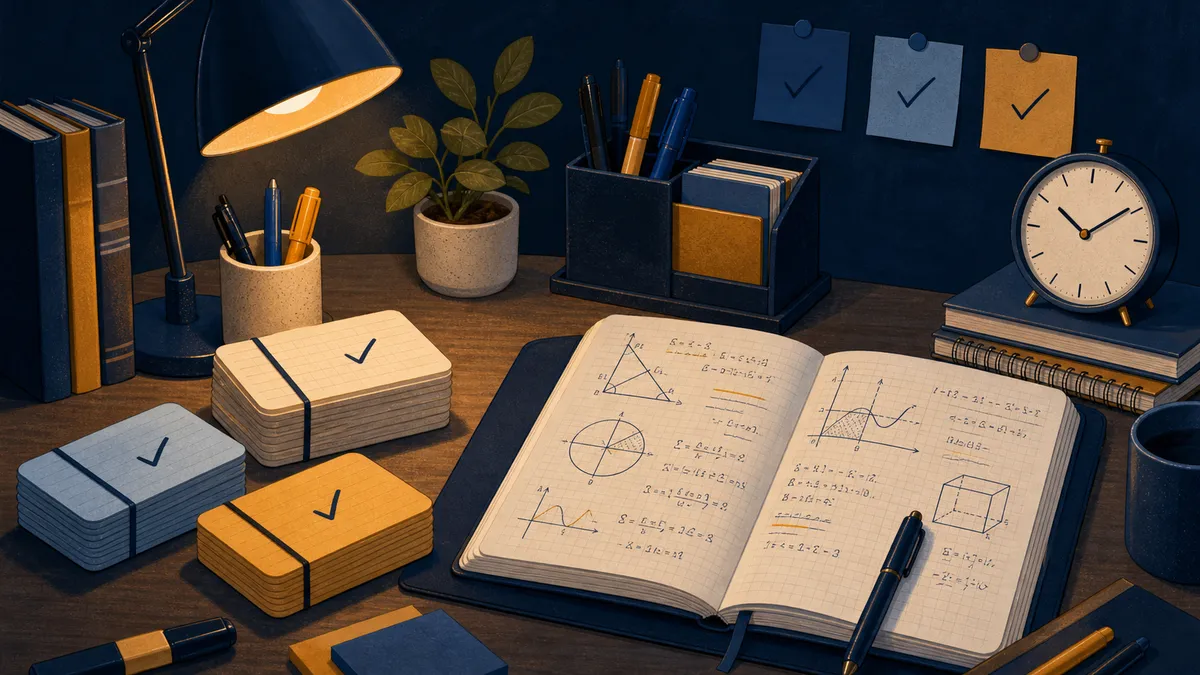
Recall before you reread
Start a session with a blank page. Write the definitions, conditions and key results you remember for a topic; then check your notes and fill the gaps. Follow this with a few questions without looking at the solution. Revisit the topic again after a gap, especially when your recall is weak.
Keep an error log that you will actually use
For each worthwhile mistake, record the topic, a short description of the question, the reason for the mistake and the correct idea. For example: “Quadratics: forgot to check whether the roots satisfied the stated interval. Next time, check the condition after solving.” A compact note is more useful than copying an entire solution you never review.
Use mock tests as feedback
Take a test under realistic conditions when you are ready, then set aside time for analysis. Sort questions into: solved confidently, solved with uncertainty, attempted incorrectly and not attempted. For each category, identify the next action: practise a concept, improve accuracy, or learn when to move on. Compare results over several tests rather than drawing conclusions from one score.
Plan the final review
- Prioritise important concepts and recurring mistakes over collecting new resources.
- Practise a mix of familiar and less familiar questions, including timed sets when appropriate.
- Keep formulas with their conditions and examples of when they apply.
- Protect sleep and breaks; fatigue makes careful reading and calculation harder.
Use the official exam information for the current year when planning. A revision schedule should be adjusted to your own progress, not copied blindly.